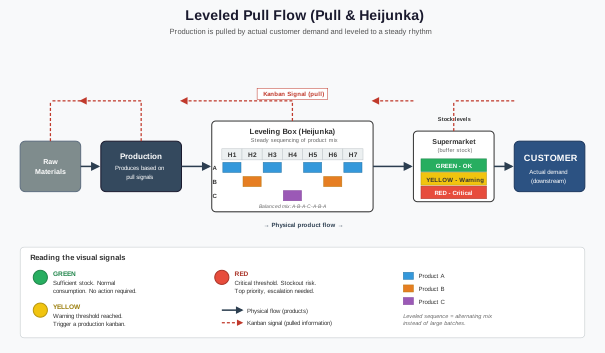
What is pull-based levelling?
Pull-based levelling was popularized by the Toyota production system. As its name implies, it is based on two principles: pulling the flow based on actual demand—which may be unstable and unpredictable—and levelling this flow to provide the industrial system with a stable signal.
It is therefore a combination of two seemingly contradictory principles:
- Responding quickly to actual demand, which may be highly random and variable.
- Generating a stable production plan, because industrial operations require stability to be efficient.
Applying one principle without the other leads to serious setbacks. Historically, this has caused Lean initiatives to fail, as they remained at a superficial level of mudas elimination, without truly capitalizing on the benefits of implementing an end-to-end pull flow system.
Pulling without smoothing
You may have tried to manage your production based on simple Kanban loops, or, better yet, DDMRP buffers.
This allows you to better propagate the market signal to your operations—actual consumption, firm orders.
Production is triggered by actual customer demand (downstream), not by forecasts pushed from upstream. Each sequence of workstations produces only what the subsequent stations consume. This prevents overproduction and inventory buildup.
However, your production team quickly alerted you: we can’t constantly stretch like a rubber band to blindly follow the raw market signal.
For example, when I no longer have a demand signal for this resource, I have to stop it—but I know this is a constraint; if I lose capacity now, I won’t be able to make it up later.
More subtle but often highly detrimental, you might significantly alter the mix of products to be manufactured—which will cause sudden accelerations or decelerations in your upstream production stages and among your suppliers—and there you have the bullwhip effect you’re trying to combat!
A Kanban or DDMRP system does not guarantee smoothing. It propagates the signal of actual demand. It has mechanisms that promote smoothing: decoupling, loops sized based on a smoothed average daily demand, and relative priorities—but applied in isolation, instability threatens your operations.
Level Loading Without Pull
The original intent of the Master Production Schedule (MPS) was indeed to smooth demand. The very first MRP systems fed actual market demand into the requirements calculation, which resulted in highly variable production and procurement that were not aligned with actual manufacturing capabilities.
The introduction of an MPS was therefore intended to establish a stable signal – somehow to decouple production from demand noise. But in doing so, it led to severe disconnect from actual demand. The MPS involves infrequent revision cycles, driven by forecast revision cycles—fixed time horizons, consideration of capacity constraints that are often empirical, etc.
Initially driven by good intentions, the MPS has become a major source of inefficiency—it leads to inventory imbalances, overproduction, etc.
Combining pull signals and smoothing
The alternative to the MPS introduced by the Toyota Production System is Heijunka.
This mechanism involves spreading production evenly over time, both in terms of volume and product mix. Rather than manufacturing large batches of a single product and then switching to another, items are alternated in small quantities at a steady pace.
What is essential is that this mechanism is driven by a pull signal—Heijunka spreads out over time the execution of the signal generated by the kanbans.
For example, instead of producing 500 units of Product A on Monday, 500 of Product B on Tuesday, and 500 of Product C on Wednesday, we produce a balanced mix of ABC-ABC-ABC every day, driven by actual consumption indicated by kanban cards.
Combining the two allows you to:
- Meet customer demand without overproducing
- Avoid fluctuations and load spikes that disrupt production
- Reduce inventory while maintaining a high level of service
- Facilitate the detection of anomalies through a steady work rhythm (takt time)
- Improve flexibility and quality
Historically, this level-loaded pull-flow logic has been implemented through physical systems: kanban cards, accumulation boards, heijunka sequencers, and launchers. Connecting this control method to the ERP system used to be problematic—and contributed to the fact that this operating mode has still not been widely adopted, despite its effectiveness. The link between this physical system and the information system (the ERP) often involves Excel and the capture of production reporting transactions.
The Intuiflow Digital Levelled Pull Flow
The control logic we prioritize in Intuiflow is precisely this smoothed pull flow logic. What distinguishes our approach from traditional methods relies on several mechanisms:
- The entire process is digital. It is, of course, essential today to have a digital control system.
- The Demand Driven signal provides relative priorities for whether to produce items for stock or on demand.
- The average daily demand—historical, forecast, or a combination of both—is smoothed over the appropriate time horizons.
- With end-to-end pull flow, we seek the best available downstream consumption signal—for example, the “sell-out” signal from your distribution network.
- Load smoothing and production sequencing are performed at the level of each defined constraint, using different mechanisms to adapt to each environment: planning wheel, batch processing, fixed assortment, hourly, daily, or weekly frequencies, etc.
- The same logic and the same smoothing and sequencing engine are used in the short term for firm orders, and in the longer term for planned orders and S&OP/RCCP scenarios.
- The adjustment of target inventory levels (DDMRP buffer sizes) or lead times takes load smoothing into account. For example, downstream inventory buffers are increased when we need to pull ahead to anticipate a forward period of capacity saturation.
- Requirements calculation—both short-term and long-term—takes smoothing into account—there is no need to receive components too early that we will not have the capacity to consume for several periods.
- The pull system is continuously monitored by advanced analytics to continuously improve performance—an essential element of Lean.
We believe that levelled pull flow is now more than ever the best method for balancing industrial efficiency with market variability.
That is why we are constantly improving our ability to deliver a digital signal driven by actual demand, which brings stability and efficiency to operations and is easy for users to understand, as understanding signals and priorities is essential for adopting the model.