Disclaimer: This post was partially written by an AI 😉
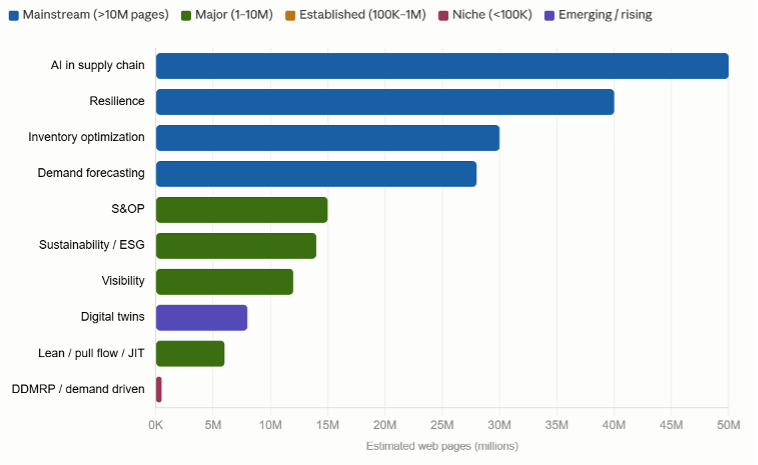
Out of curiosity, I asked Claude to estimate the number of web pages dedicated to various supply chain topics.
The number of web pages dedicated to a topic naturally depends on the priorities of solution providers, who promote the topics that will help them sell their technology or services. This also reflects the concerns of companies seeking solutions to improve their workflows.
I expected AI to be in the top tier, and I wasn’t disappointed, with an estimate of over 50 million web pages referencing AI in the supply chain. The interest is undeniable, even if tangible results in terms of return on investment remain rather slim. There is undoubtedly still a bit of marketing hype influencing the topic…
I thought the forecasting process and S&OP would come right after, given the historical weight of these topics in supply chain practices. They remain important - with, for example, around 30 million pages dedicated to forecasting - but awareness of unpredictability has come a long way.
The pleasant surprise is the prominence of the topic of resilience and risk. Presumably, the years of COVID, Brexit, the war in Ukraine, tariffs, the Suez Canal, or the Strait of Hormuz have done their work and brought these risk issues to the forefront…
According to a 2024 KPMG survey, the resilience of their supply chains is now among the top three risks identified by CEOs for their companies.
According to Claude’s assessment, inventory optimization comes close.
Curiously, at the bottom of this ranking, we find pull systems and their Demand Driven variant.
The gap between the paramount importance of the need for resilience and inventory optimization, and the low adoption of pull-based practices, strikes me.
From my experience of over 40 years in supply chain management, it is precisely the deployment of pull-based tactics—based on an operational model that incorporates adequate buffers and continuously adapts to actual demand—that enables us to strengthen resilience and optimize inventory.
Surprised by this discrepancy, I asked Claude how to explain that gap. The answer is instructive and thought-provoking in several ways:
“The paradox of effective but invisible solutions
DDMRP and Demand Driven methods do indeed effectively address resilience and inventory optimization - the facts prove it. But effectiveness and visibility on the web are two very different things. Web pages are generated by problems, not by solutions. Resilience and inventory optimization are recurring pain points felt by millions of companies, generating a multitude of blog posts, vendor white papers, conferences, and press articles. DDMRP is a specific response to these problems, adopted by a much smaller community.
Several structural reasons exacerbate this phenomenon:
The maturity and age of the terminology. “Supply chain resilience” and “inventory optimization” are broad, intuitive labels that anyone can use. DDMRP is perceived as a proprietary methodology with a higher lexical barrier—decoupling points, net flow position, buffer zones. This linguistic friction limits spontaneous adoption and creation of content.
The issue with incumbent systems. The vast majority of companies still use traditional MRP/ERP systems. Their vendors (SAP, Oracle, Microsoft…) have hundreds of thousands of pages of documentation, marketing content, and support materials for these systems. They may have only recently added DDMRP as a module or option - it is not their core business. The content ecosystem therefore, naturally reflects the installed base, rather than available best practices.
The consulting and solution provider economy. Major consulting firms (McKinsey, Deloitte, Gartner) generate enormous volumes of web content on resilience and inventory optimization, as these are the themes of multi-million-dollar engagements sold to large enterprises. DDMRP is typically implemented by smaller, specialized firms, whose content production capacity is much more limited.
Resilience is an executive-level topic; DDMRP is an operational one. Following the disruptions caused by COVID, resilience has become a topic of discussion on corporate boards, covered by the Financial Times, the Harvard Business Review, and CEO surveys. This generates a massive volume of content. DDMRP is the domain of operational and supply planning teams - it rarely surfaces at the executive level, where high-volume content is produced.
The irony of the situation
This discrepancy reflects failure on the part of companies rather than a methodological shortcoming. Companies suffering from low resilience and excessive inventory generate all this content because they haven’t solved the problem. Companies that implement Demand Driven approaches tend to deal with it quietly—they have less urgency to publicize their difficulties, and the community of specialists is relatively insular, centered around a handful of practitioners.
In this sense, the low prevalence of content on DDMRP does not prove that it is less important - it could indicate that it remains underutilized relative to its potential, while the problems it solves continue to generate significant attention on a large scale.”
Thank you, Claude, for these explanations… A note to companies concerned with the resilience of their supply chain and the optimization of their inventory investments: there are proven solutions, foremost among them Intuiflow by Algo…
We can talk all about it together if you prefer it !